
Defining Digital Humanities at the CSU
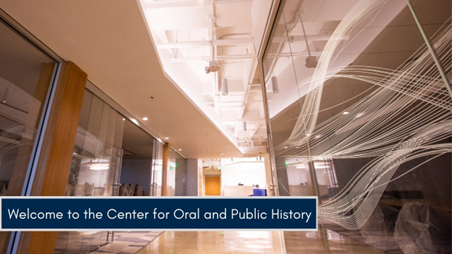
While convening at the first DH@CSU Gathering, conversation topics fluctuated between statewide campus practices and defining the term “community.” Participants gathered around tables in the CSUF Center for Oral and Public History and through a large screen activated by zoom. Between breakfast bites and dangling conference lanyards, we found ourselves sitting next to each other — a Chicana community leader of Orange County and a Samoan-Korean ethnic studies faculty from CSU Bakersfield.
Most people outside of the Digital Humanities (DH), might imagine white techy experts and prestigious scholars exploring documentation or maybe even exploiting history or narratives from other communities. However, at this DH gathering, Ethnic Studies was the main topic of conversation, along with efforts grounded in intergenerational knowledge and equitable practices from within and involving Black, Indigenous and people of color (BIPOC) scholars and communities. During the first day, we collectively diagrammed words and intersections to contemplate a mission statement that would be adapted across 23 CSU campuses, with the hopes of building partnerships with off-campus communities.
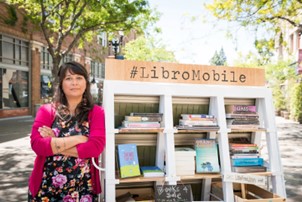
As we organized into workgroups, we (Sarah Rafael Garcia, founder of LibroMobile Arts Cooperative and Dr. Jeremiah Sataraka at CSUB) found ourselves focused on Outreach and Internal Communications. We held a conversation with Dr. Jamila Moore Pewu convening host and Co-PI on the National Digital Ethnic Futures Consortium Grant and Dr. Ayana Jamieson, an assistant professor of Ethnic Studies at Cal Poly Pomona and founder and creative director of the Octavia E. Butler Legacy Network (OEBLEgacy).
One thing we all agreed on is that the Digital Humanities is a community activity, and usually involves a great deal of collaboration and communication to assemble the relevant expertise for any given project. This led us to also counter some of the (aforementioned notions) historically white DH models in academic institutions and generalized terms like “community” that have been co-opted through white hierarchical processes in DH practices. The Digital Humanities does not require an academic degree, nor does it solely apply to the English language or institutions. DH has existed in various forms for decades, it is something grassroots organizers and Ethnic Studies educators have used to make social justice issues visible through digital platforms for advocacy and accountability.
Recurring questions in our thread of ideas were: How will DH@CSU differ from other white-led DH departments and/or institutions? How will Ethnic Studies and BIPOC voices comprise and be centered as the foundation of the mission and ongoing goals?
Although we initially tasked ourselves with answering these complicated questions, the only answer we could actually document was to build more visibility for people like us doing the work without institutional support or organized networks. Between all four of us, we have a list of DH projects in various stages and know there are more who deserve to be highlighted across the state.
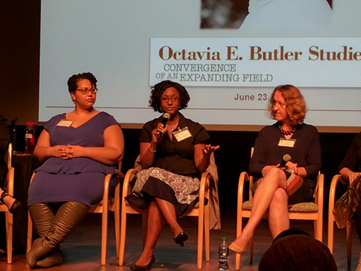
Ayana Jamieson was compelled to found Octavia E. Butler Legacy Network in 2009 after an embodied research visit to award-winning working-class speculative fiction author Octavia E. Butler’s final resting place in Altadena, California, way before the pandemic necessitated kinds of digital and remote work. During her dissertation research, OEBLegacy emerged from a vacuum of the field she coined “Octavia E. Butler Studies” and praxis of mapping Butler’s life and work across time and space with literal tours of psychological and geographical landscapes. Jamieson needed to reach out around Butler’s work in both virtual and physical spaces with labor done without the endorsement or support from any singular institution and required connecting with existing fans/activists/scholars/artists/everyday folks across the globe and doing what Dr. Alexis Pauline Gumbs calls community accountable scholarship. Eventually, Dr. Moya Bailey joined Jamieson as a #digitalalchemist for OEBLegacy which has always had the lived experience of marginalized folks centered intersecting Bailey’s work of coining “misogynoir” and enacting the “transformative magic of women of color online.”
To date, OEBLegacy continues to do ethnic studies-centered work via ongoing projects with San Diego New Children’s Museum on the upcoming “Octavia E. Butler: Seeding Futures” exhibit (2024 and beyond), ongoing projects with American Artist, writing or speaking for broad public audiences (The Feminist Wire, Public Books, Sierra Club Magazine, BILD, NPR , The New York Times and elsewhere). The work has been international and varied from editing special issues of academic journals to collaborative advising arts nonprofits and statewide humanities organizations to TedEd curriculum development to convening conferences at several places: “Ferguson is the Future” (2015) at Princeton University in collaboration with Bailey and sociologist Ruha Benjamin, “Octavia E. Butler Studies: Convergence of an Expanding Field” (2017) at the Huntington Library (where Butler’s papers are cataloged), and “Shaping Change: Remembering Octavia E. Butler through Archives, Art, and Worldmaking” (2016) in collaboration with literature and ethnic studies professor Dr. Shelley Streeby at UC San Diego.
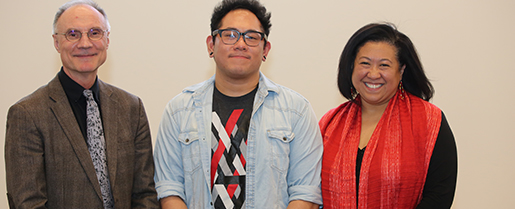
Jeremiah Sataraka’s introduction to the formal world of DH was back in 2019 when he was selected as a fellow for the Palouse Digital Scholarship Symposium. This was a week-long joint program hosted by Washington State University’s Center for Digital Scholarship and Curation and the University of Idaho’s Center for Digital Inquiry and Learning. Back then he was working on his dissertation research, which included documenting the oral histories and experiences of QTPIs (pronounced “cutie-pies”) Queer and/or Transgender Pacific Islanders, something he’s still working on today.
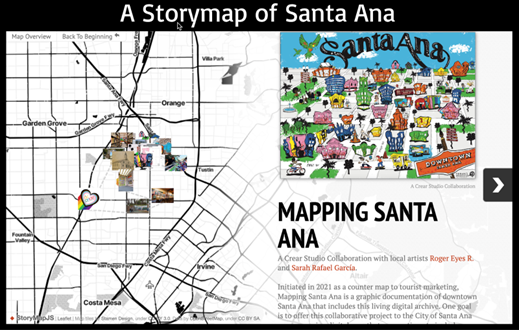
Sarah Rafael García started exploring with DH before she knew it was a term. Her project SanTana’s Fairy Tales (awarded 2016-2017 in part by the Andy Warhol foundation), incorporated digital archives produced by a CSUF history student and the book is now an Ethnic Studies required text in the Santa Ana Unified School District. Soon after, she ventured into virtual timelines and DH research as a 2019 UH KGMCA Project Row Houses Fellow and 2020 US Latino Digital Humanities (USLDH) Grants-in-Aid program grantee, funded by the Mellon Foundation. Sarah Rafael received direct DH mentorship from Dr. Gabriela Dr. Baeza Ventura during both projects. Now, she has established the first for-and-by community-based Digital Archives project in Orange County via LibroMobile Arts Cooperative, which includes teaching community members how to preserve oral history and digitally archive familial albums and memorabilia. Through this work, she has also established Mapping Santa Ana and BIPOC Art Spaces, which aims to preserve BIPOC arts history in Orange County while building on anti-gentrification movement culture.
By Sarah Rafael Garcia, Jeremiah Sataraka, and Ayana Jamieson
 Instagram
 Bluesky
 Humanities Commons